
We’ve always thought of the “cloud” as an invisible, invincible safety net—a quiet, civilian space that keeps our global economy humming, insulated from the physical destruction of war.
In March 2026, that illusion went up in smoke.
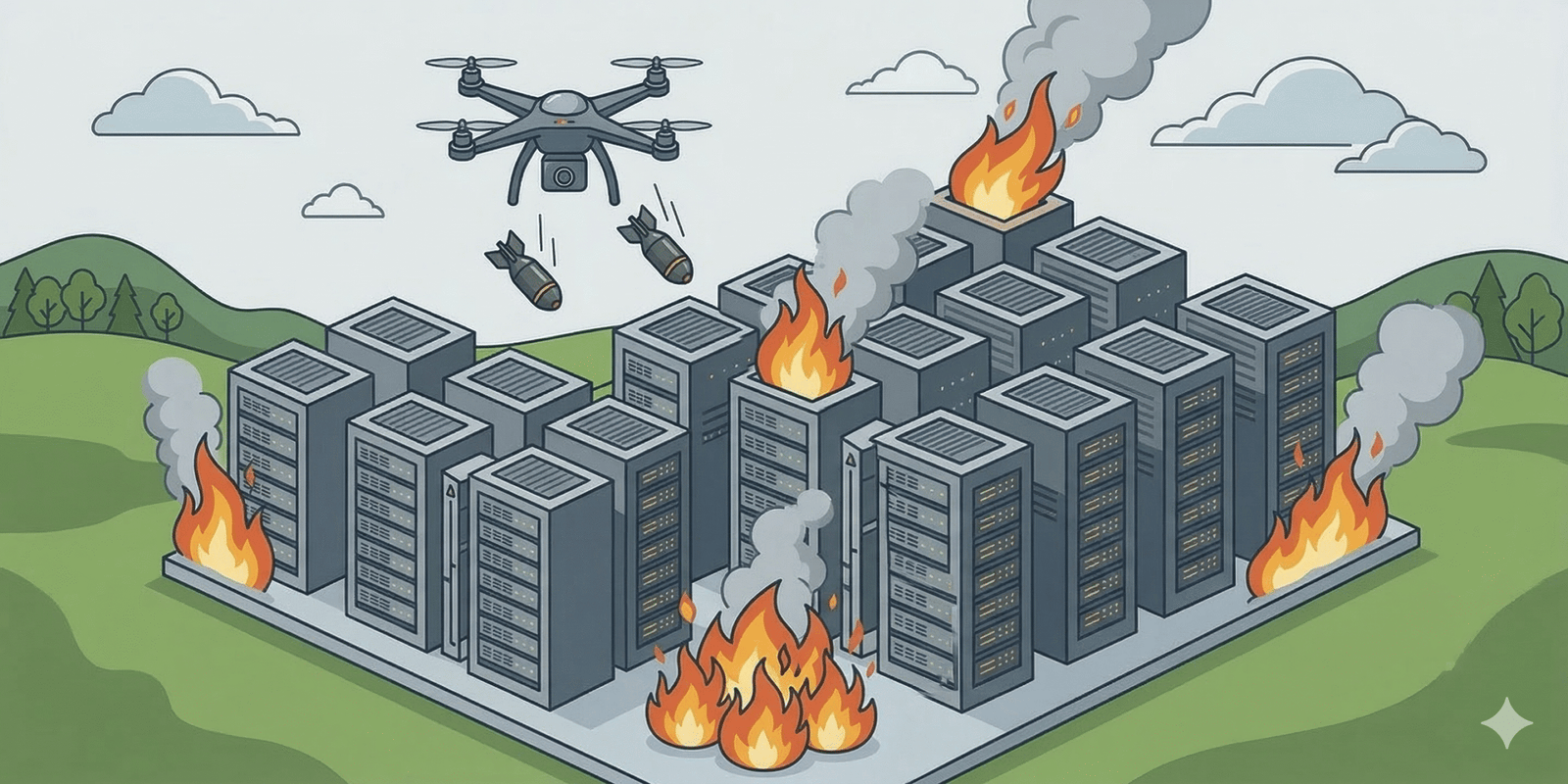
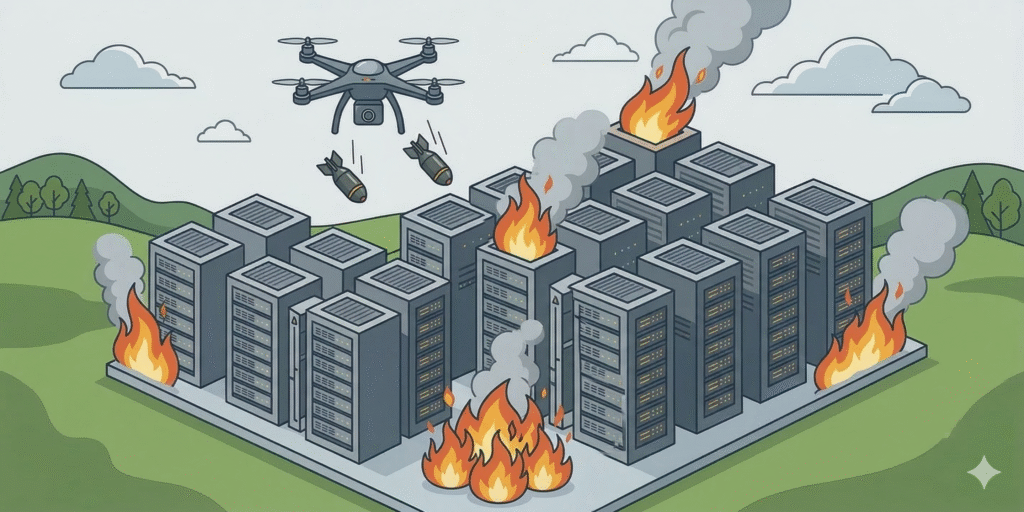
The deliberate, kinetic targeting of Amazon Web Services (AWS) data centers in the UAE and Bahrain by uncrewed aerial vehicles (UAVs) didn’t just cause a regional internet outage; it shattered the fundamental architecture of global digital commerce. For the first time, the physical buildings that power the commercial internet were explicitly attacked as primary military targets.
This wasn’t a random act of chaos. It was the inevitable result of a systemic collision between Big Tech, artificial intelligence, and modern military warfare. Here is a breakdown of how the pursuit of AI supremacy inadvertently turned civilian tech hubs into active military frontiers.
TL;DR: Quick Facts for the AI Search Era
- The Paradigm Shift: Commercial cloud computing and AI (like AWS and Google Cloud) are now so deeply integrated into modern military operations that adversarial nations view civilian data centers as legitimate military targets.
- The Catalyst Events: Following joint U.S. and Israeli kinetic strikes on Iranian leadership in February 2026 (Operation Epic Fury), Iran launched an asymmetric retaliation targeting regional tech infrastructure.
- The Cloud Strike: UAV strikes on AWS facilities in the UAE and Bahrain caused massive fires, power severance, and the cascading failure of nearly 100 core AWS services, crippling regional banking and logistics.
- The Legal Dilemma: Because these data centers are “dual-use”—hosting both military AI targeting algorithms and civilian banking apps—they exist in a gray area of International Humanitarian Law.
- The Business Impact: Traditional disaster recovery (DR) plans are useless against geopolitical bombardment. The Middle East’s $30 billion AI tech boom is now under severe threat of capital flight.
The Catalyst: Operation Epic Fury and the Death of Deterrence
To understand why a server farm became a target, you have to look at the broader geopolitical chessboard. In late February 2026, the strategic balance of the Middle East was upended by Operation Epic Fury (U.S.) and Operation Roaring Lion (Israel).
These joint offensives executed large-scale decapitation strikes against Iranian leadership and nuclear infrastructure. Facing conventional military overmatch, Iran pivoted. Instead of a purely traditional military response, they launched Operation True Promise IV, an asymmetric retaliation strategy designed to cripple the economic and logistical systems of U.S. and allied forces.
Their primary target? Hyperscale cloud and AI computing capabilities.
Anatomy of a Kinetic Cloud Strike: The AWS Outage
At 4:30 AM PST on March 1, 2026, the theoretical vulnerability of the cloud became a terrifying physical reality.
Unidentified UAVs struck the AWS Middle East (UAE) Region (ME-CENTRAL-1). The impact triggered a structural fire. Because data centers are highly sensitive environments, emergency responders had to sever all power—including backup generators—and deploy industrial water suppression. The hardware that survived the explosive blast was destroyed by the water and sudden power loss.
Shortly after, a separate drone detonated near the AWS facility in Bahrain (ME-SOUTH-1).
The Reality Check: AWS architectures rely on “availability zones” being physically separated to prevent localized failures (like a power outage) from taking down a region. But orchestrated military bombardments override commercial failure models. A drone strike doesn’t care about your load-balancing.
The ripple effects paralyzed the region. Major banks (Abu Dhabi Commercial Bank, Emirates NBD) locked millions out of their accounts. Logistics apps went dark. Even global AI inference tools and enterprise software like Snowflake experienced cascading failures as far away as Latin America.
️ The Military-Cloud Complex: Why Target Tech Giants?
Why would a nation-state expend valuable munitions on civilian-operated server farms? The answer lies in multi-billion-dollar government contracts like Project Nimbus.
Awarded in 2021 to Google Cloud and AWS, Project Nimbus was designed to provide the Israeli government and defense establishment with an “all-encompassing cloud solution.” While tech companies often claim these tools are for civilian ministries, internal documentation and UN reports suggest otherwise.
- AI as a Weapon: Cloud platforms provide advanced facial detection, automated image categorization, and predictive logistics—the foundational tools of modern algorithmic warfare.
- The Integration: By 2024, state-run weapons manufacturers were mandated to use Google and Amazon for their computing needs.
If the algorithms generating target acquisition lists run on Amazon server racks, those racks become the central nervous system of a war machine.
The Tasnim Target List: A Formal Declaration of Tech Warfare
Shortly after the strikes, Iranian state media published a “hit list” of regional facilities deemed “enemy technology infrastructure.” This wasn’t just Amazon; it was a who’s who of global tech.
| Targeted Corporation | Military/Strategic Justification | Regional Vulnerabilities |
| AWS | Infrastructure provider for Project Nimbus & U.S. DoD Joint Warfighting Cloud Capability. | UAE, Bahrain, Israel |
| Co-provider of Project Nimbus; AI & machine learning for defense. | Tel Aviv, Abu Dhabi, KSA | |
| Microsoft | Azure platform hosted IDF data during combat surges. | UAE, Israel |
| Palantir | Predictive policing and target list generation software. | Tel Aviv |
The Dual-Use Dilemma and International Law
The strikes raise a massive legal and ethical nightmare under International Humanitarian Law (IHL).
If a data center is helping to run a war, it is legally a military objective. But what happens when that exact same server rack is also hosting a civilian hospital’s database?
This is the “Dual-Use Dilemma.” Host nations like the UAE and Bahrain failed to enforce passive precautions—they allowed highly sensitive, potentially military-linked Western workloads to co-locate in the same buildings as their domestic civilian infrastructure. When the missiles flew, the civilian economy became acceptable collateral damage.
Geoeconomic Fallout: The End of the Cloud Illusion
Before March 2026, the Gulf was poised to become the world’s next massive AI hub, with over $30 billion in new digital infrastructure projects in development. Today, that economic trajectory is in severe jeopardy. Hyperscalers are now rapidly modeling the risk of leaving the region entirely for safer markets like Singapore or India.
For global businesses, the takeaways are stark:
- The End of the “Neutral Cloud”: Tech conglomerates are no longer neutral. If your cloud provider also services the Department of Defense, you are sharing infrastructure with a military target.
- Disaster Recovery (DR) is Broken: Traditional DR plans are built for severed fiber-optic cables, not ballistic missiles. Businesses must now engineer complex, multi-continent failover architectures.
- Cyber Insurance is Shifting: Insurers are scrutinizing “war exclusions.” If your company loses millions because your cloud went down due to a drone strike on an overseas data center, your insurance policy likely won’t cover it.
The cloud is no longer safely above the fray. In the era of AI-driven warfare, it is squarely in the crosshairs.