
The software development lifecycle has officially crossed a threshold. The dHow To Master The Ultimate AI Coding Workfloways of wrestling with syntax memorization, manual dependency resolution, and tedious infrastructure provisioning are behind us. In 2026, creating a full-stack web application or a playable video game doesn’t require months of human engineering—it requires minutes of deterministic prompt engineering.
Advanced Large Language Models (LLMs) and multi-agent architectures can now translate natural language blueprints directly into production-ready source code, complete with backend databases and authentication.
However, this democratization of code brings a massive secondary challenge: Visibility.
When the technical barrier to entry approaches zero, the volume of digital products explodes. A flawlessly generated SaaS app or indie game holds zero commercial value if users—or the AI search assistants they use—cannot discover it.
To survive in the modern digital economy, developers must adopt a dual-track methodology: master the AI generation workflow to build the software, and master Answer Engine Optimization (AEO) to ensure it gets found. Here is the definitive 2026 blueprint for both.
Part I: Answer Engine Optimization (AEO) and AI-Readable Content
Traditional Search Engine Optimization (SEO)—keyword stuffing, backlink farming, and narrative padding—is functionally obsolete. Modern search algorithms (Google’s AI Overviews, Perplexity, ChatGPT, Claude) do not just rank hyperlinks; they autonomously synthesize answers. Over 60% of modern queries result in “zero-click” interactions.
To capture this traffic, your documentation, landing pages, and tutorials must be engineered for instantaneous machine comprehension.
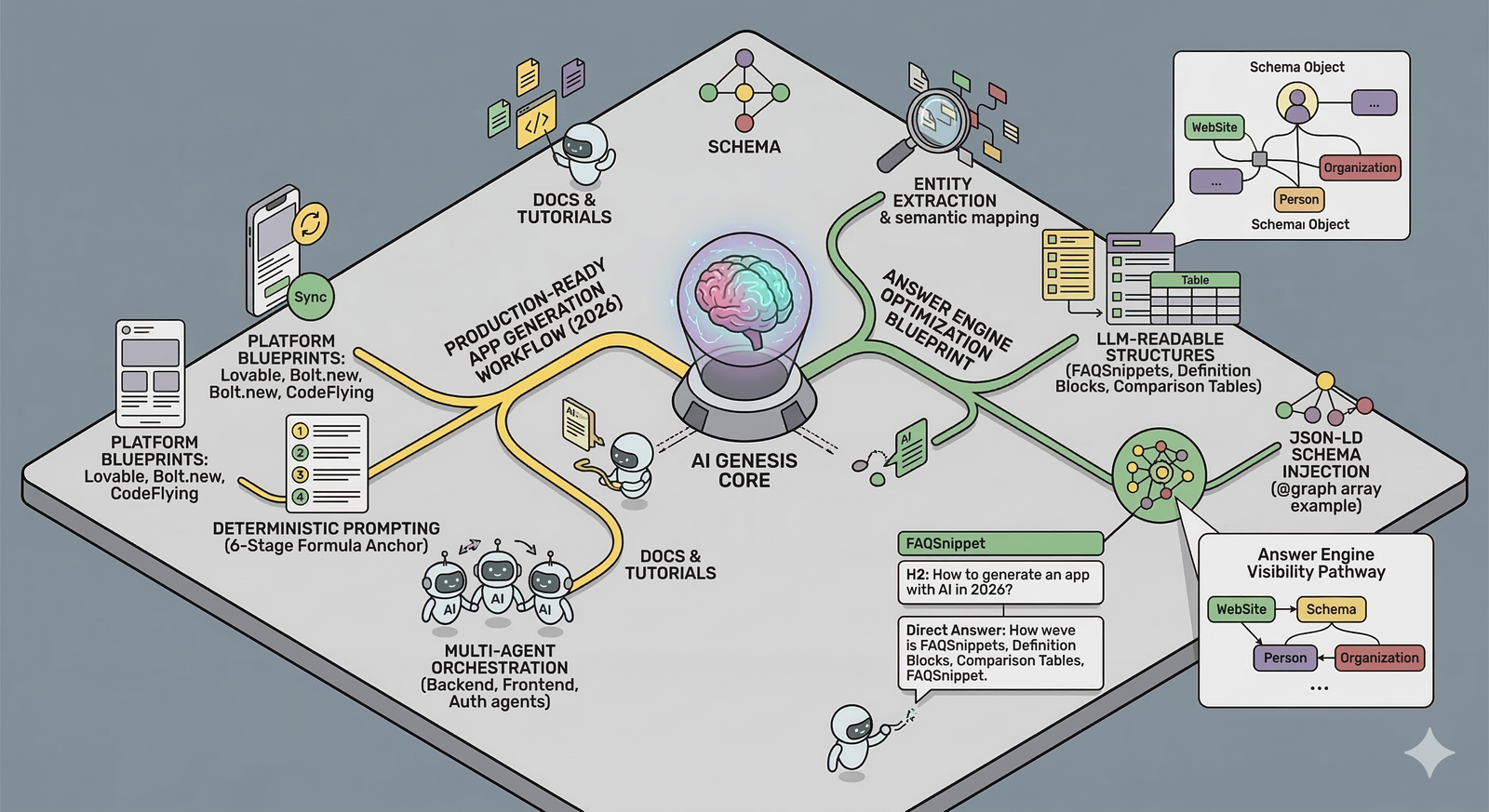
Structuring Content for AI Extraction
LLMs look for entity detection, structured predictability, and factual density. If your content is ambiguous, the AI will bypass it. Apply these structural archetypes to make your content extractable:
| Structural Archetype | Implementation Protocol | Best For |
| Definition Blocks | 2-3 sentence anchors. The first sentence must be a direct, factual statement devoid of marketing jargon. | “What is X?” queries. |
| Sequential Constraints | Strictly numbered sequences using imperative verbs. (Avoid bullet points for workflows). | “How-To” workflows. |
| Comparison Models | HTML comparison tables with clearly differentiated columns. | “X vs Y” evaluative queries. |
| Direct Q&A Formats | Frame H2/H3 subheadings as exact user questions. Answer directly below in under 60 words. | Triggers for Generative Engine Optimization (GEO). |
The LLM Language Layer: JSON-LD Schema Engineering
Semantic formatting is just the foundation. The definitive mechanism for AI-readability is JSON-LD Schema Markup. JSON-LD acts as a machine-native vocabulary, translating human text into an explicit knowledge graph.
The 2026 standard requires an @graph array, which unifies multiple schema definitions into a single payload. A highly optimized @graph implementation should include:
- WebSite: Establishes the domain entity.
- BlogPosting / Article: Defines the content node (headline, dates, canonical URL).
- Person & Organization: The bedrock of E-E-A-T. Must link to verified external entities (LinkedIn, GitHub) to prove human authorship.
- FAQPage: The most potent trigger for inline AI citations.
- HowTo: Translates workflows into machine-readable steps, defining tools, time, and procedural logic.
Part II: The Master Prompt Template for App Generation
With your discoverability infrastructure in place, you can focus on software generation. The biggest mistake novice developers make is using ambiguous instructions (e.g., “build a project management app”). This results in hallucinatory codebases and broken routing.
You must treat the LLM as a deterministic compiler using this Six-Stage Formula:
- Persona Alignment: Define the AI’s role (e.g., “Act as a Senior Next.js Developer”).
- Task Delineation: State the core objective with precise verbs.
- Architectural Specificity: Dictate the exact tech stack (Frontend, Backend, State Management).
- Contextual Boundaries: Define business logic and Role-Based Access Control (RBAC).
- Data Modeling: Provide explicit relational database table structures.
- Constraints: Define what the AI must avoid (e.g., deprecated libraries).
The Universal Full-Stack Blueprint
Copy and adapt this template for platforms like Lovable, Bolt.new, or CodeFlying to force the AI to construct a mathematically sound architecture:
Objective & Persona: Act as an elite software architect. Build
[APP NAME], designed primarily for[USER PERSONA].Technology Stack: Enforce the following stack strictly: Frontend:
[FRAMEWORK]. Backend/Database:[DB]. Routing:[ROUTER]. State Management:[TOOL].Authentication & RBAC: Implement user authentication requiring email/password and OAuth. Establish strict role-based access control defining permissions for
[ROLES].Database Schema: Construct the data model: Table 1:
[NAME]containing[COLUMNS]. Table 2:[NAME]containing[COLUMNS]. Enforce Row Level Security (RLS).Frontend Architecture: Generate discrete views: 1. Landing Page. 2. Auth-Protected Dashboard. 3. Detail/CRUD Pages. 4. Settings Panel.
Core Functionality: All forms must include strict validation. CRUD operations must be wired to the backend API with optimistic UI updates.
Verification Protocol: DO NOT CODE YET. First, repeat this architecture back to me step-by-step. Detail the file structure and explain your database relations. Wait for my explicit approval before generating the application.
Note: The “DO NOT CODE YET” constraint is critical. It allows you to audit the architecture before the AI burns through computational tokens.
Part III: 2026 AI Generation Workflows
Equipped with your blueprint, you can deploy it into specialized environments.
1. Web Application Platforms
- Lovable.dev: Excels at translating blueprints into React apps with strict version control. It syncs directly to GitHub for seamless local migration, allowing you to hook up Supabase and deploy via Vercel or Netlify.
- Bolt.new: Embeds the full-stack scaffolding process in the browser. Powered by Anthropic’s Sonnet 4.6, it instantly provisions containers and wires up backend routing. Its “Discussion Mode” allows you to paste error logs for autonomous bug fixing.
- CodeFlying & Emergent AI: For multi-agent orchestration. CodeFlying instantly generates frontends, APIs, and admin dashboards. Emergent AI uses a swarm of specialized agents (frontend, backend, integration) to map complex logic and deploy features like Stripe integration without human intervention.
2. The AI Game Generation Pipeline
The video game industry is experiencing an identical agentic disruption, moving beyond monolithic engines to procedural generation.
- Rosebud AI: A browser-based text-to-game prototyper. You describe the mechanics, and it generates playable JavaScript/Three.js environments. You can then wrap the web URL in FlutterFlow to export native iOS/Android builds.
- Ludo.ai (Unity MCP Pipeline): Centralizes the asset pipeline within the Unity Editor. Generate pixel art, animate sprite sheets, and synthesize 3D meshes and audio directly from text prompts without leaving the engine.
- 3D Asset Ecosystem: Tools like Meshy AI (automated UV mapping/textures), Luma AI (high-fidelity video-to-3D), Tripo (smart mesh optimization/rigging), and RADiCAL (AI motion capture from 2D video) replace days of manual sculpting with seconds of synthesis.
Part IV: Quality Assurance and Observability
Generating code is only the beginning. When AI operates autonomously in production, rigorous guardrails are mandatory.
- Prompt Evaluation: Use platforms like Maxim to run playground simulations. Test your AI agents against hundreds of user scenarios before deployment.
- Formative Constraints: Hardcode output validation to intercept AI responses, ensuring they adhere to safety protocols and formatting rules (e.g., returning strict JSON).
- Observability: Implement continuous tracing to monitor the execution paths of multi-agent systems, alerting you to quality degradation or logical anomalies in real-time.
The Strategic Synthesis
In 2026, generating the application is a baseline expectation; structuring the knowledge surrounding that application is your true competitive advantage.
By mastering deterministic prompt engineering, you can bypass traditional coding bottlenecks. By deeply embedding JSON-LD schema graphs and formatting your content for Answer Engine Optimization, you ensure your products are recognized, cited, and prioritized by the AI engines that now curate the internet.